teraz.live
Collective Live Ambient Experience
- live,
- sound,
- web
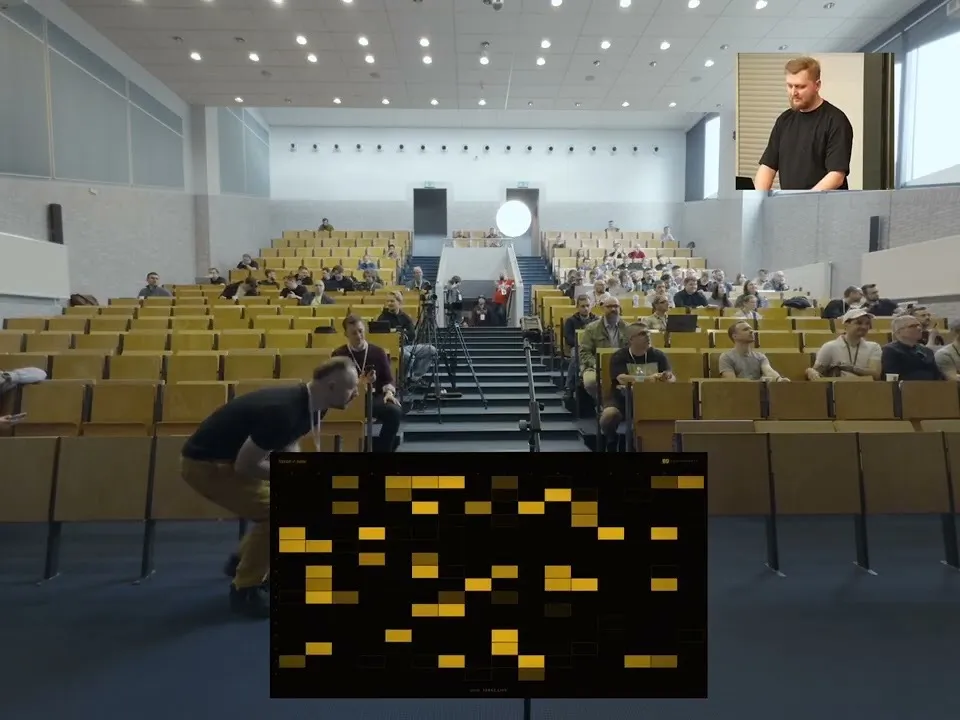
TERAZ is a collective live ambient experience. The audience’s phones become one distributed orchestra: each person plays a single layer of sound, and I bring the instruments in one by one from my laptop. The first time it really worked was in April 2026 at the wroclove.rb conference in Wrocław, with about seventy phones in the room.
Why “now”
Teraz is Polish for “now”. I’ve been orbiting ambient music for years – as a DJ, a listener and one of the people behind Up To Date Festival – while writing code for a living. TERAZ is where those two halves finally meet. At concerts, phones usually pull us out of the room: we film, take photos, check notifications. Here the phone stays in your hand but changes its job. To keep playing, you have to touch the screen every now and then so it doesn’t go to sleep. Stop to take a photo or check something else, and you drop out of the orchestra.
How it works
I start by explaining the rules, then people scan a QR code on the main screen. The system randomly gives each person one of six parts: bass, piano, crackling noise, angel pads, drone or bells. Once I press start, the QR code turns into a visualisation – a grid of rectangles, one for every participant.
My control panel sits somewhere between a mixer, a conductor’s desk and a small emergency room. I can see every track with its volume slider, plus a list of participants with their instruments and operating systems. I can move anyone to a different part by hand, which matters: some Android phones play almost nothing below about 120 Hz, so the bass is better left to iPhones.
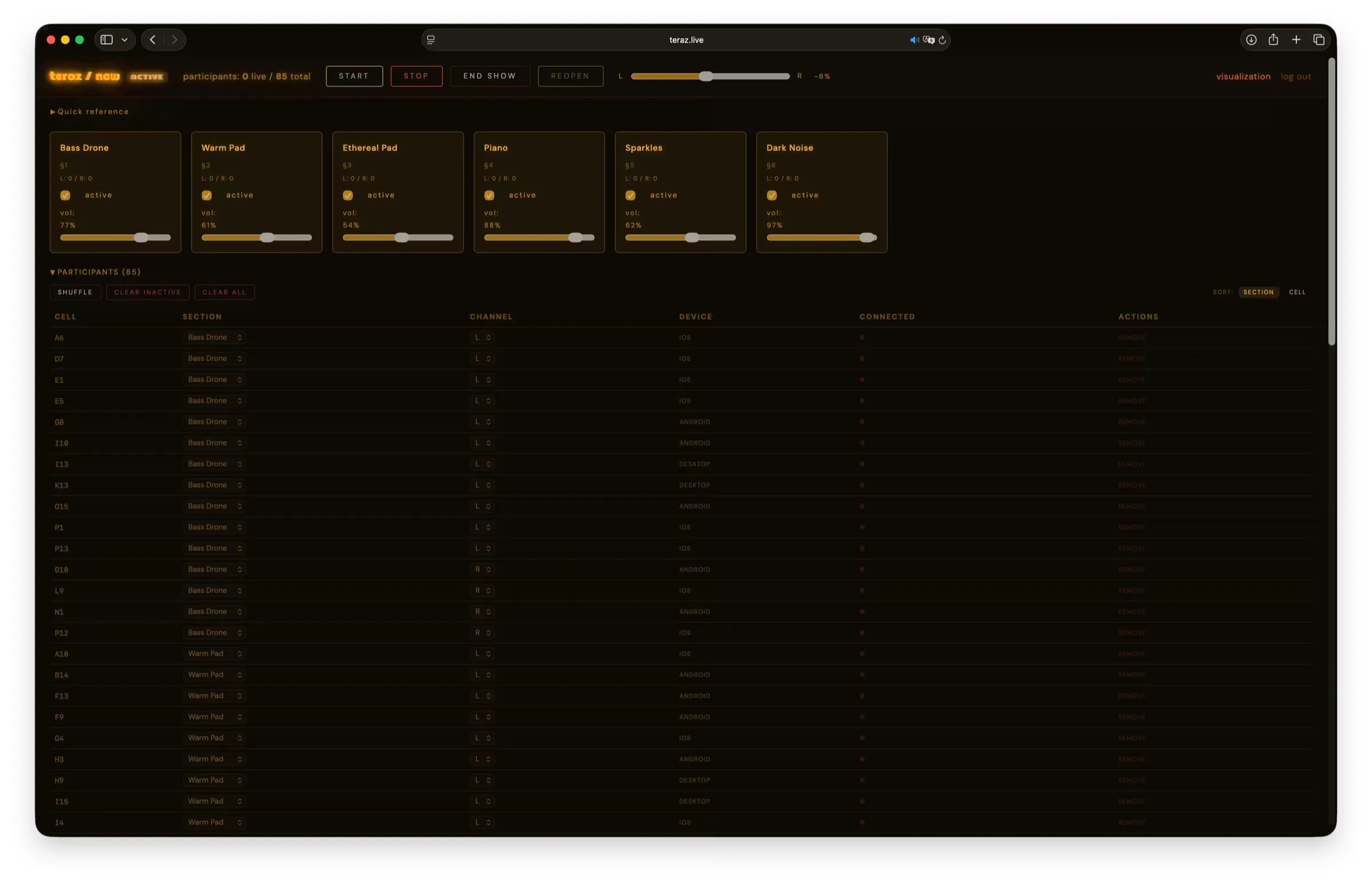
No audio is streamed. Every phone can play every instrument locally with Tone.js, and the server (Ruby on Rails, Action Cable, Stimulus, Hotwire) only sends tiny control messages: which track is on and how loud. The one exception is the piano, a sample downloaded to the phone. Each instrument drifts randomly within a set range, and I kept the small timing differences between devices because in ambient music they add life. I first hunted for the sounds on an Ableton Move and only then rebuilt them in code. Some tricks came from my earlier piece pogwar, like a silent MP3 looping in the background to keep JavaScript alive on phones.
Next
TERAZ was on the programme of Beyond Code 2026 (1–2 October, Władysławowo). I’d like to take it into more ambient and art-oriented settings, and to bigger rooms – with this piece, every extra phone makes a real difference.
Sources
- TERAZ – live collective ambient experience made with Rails & Tone.js, Arkency blog, 18 September 2026
- TERAZ live @ wroclove.rb 2026, YouTube
- wroclove.rb 2026, 17–19 April 2026, Wrocław
- Beyond Code – programme
- teraz.live